Edward Jones
2025
Designing the Advisor of Tomorrow

Overview
What if we could give Financial Advisors their time back, trading manual data entry and fragmented systems for predictive insights and automated workflows?
This was the driving question behind our engagement with Edward Jones. The business had built a highly customized Salesforce instance that essentially mirrored their 20-year-old legacy system. It was comfortable for users, but technically unsustainable and unscalable.
As the Lead Designer, my task was to bridge that gap by showcasing out-of-the-box-first strategies, while still ensuring the daily workflows of Financial Advisors were improved, not disrupted. Using insights from branch visits, I redesigned their core spaces - like Homepage, Households (Relationship Groups) and Contact records using 80% native Salesforce Components.
To get buy-in, I didn't focus on technical debt; I focused on user storytelling. I showed them how native features like AI transcription to automate note-taking can save Advisor's time. How connecting Marketing Campaigns to leads and opportunity could grow their client base directly impact their top priorities of growing "Assets Under Care" and reaching new households. Ultimately, we successfully shifted their 2026 roadmap towards adopting native product functionality and secured a $9M license renewal.
Problem
Establishing a vision with eroded trust
Edward Jones — a wealth management firm with 20,000+ financial advisors across North America — was undergoing a major Salesforce platform transformation.
When we began our assessment, the firm was operating in a “comfort trap.” To ease the transition from a decades-old legacy system, they had built a heavily customized Salesforce instance that simply mirrored their old, backward-looking screens.
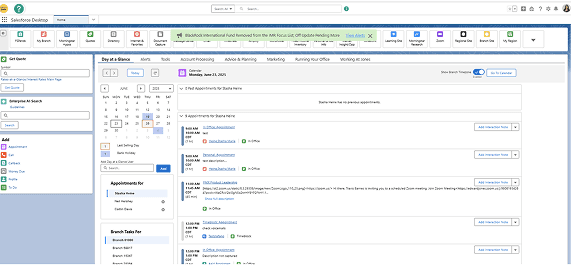
* Intentionally blurred for privacy
The engagement came with a uniquely complex stakeholder dynamic:
Three-way tension between Customer, Implementation Partner, and our team, each with differing priorities and definitions of “out-of-the-box” (OOTB)
A fractured client-Salesforce relationship that needed repair alongside design delivery
Fragmented Workflows: The UI was heavily task-driven and calendar-centric, leaving little room for CRM insights, opportunity management, or growth tracking.
Massive Technical Debt: Custom solutions ignored platform growth, causing slow load times and preventing the adoption of native AI or automation.
Disconnected Users: Features were not persona-driven. Financial Advisors (FAs) and Branch Office Administrators (BOAs) were forced into the same cumbersome layouts, leading to low adoption and high frustration.
Design Challenge
How do you define a future-state experience vision that maximizes Salesforce investment – while balancing technical constraints, partner interpretations, and a client who had lost trust?
Solution
My Approach
1. Establishing a shared experience vision
Rather than designing feature-by-feature in isolation, I drove a holistic epic-level experience vision that connected various features under a coherent future-state narrative. This involved:
Employed story narrative to demonstrate user journey across home, relationship group, notes, leads, opportunities management, and marketing campaigns features.
Creating detailed wireframes that served both as client-facing vision artifacts and developer-ready references
Facilitating experience reviews and design sessions with cross-functional teams between Customer, Partner and Salesforce.
Connect CMS Image fields (Image 1–10)
2. Navigating a 3-way stakeholder dynamic
The most complex challenge on this engagement was aligning three parties with genuinely different incentives. Partner interpreted “OOTB” as current-state configuration; Salesforce advocated for true OOTB exploration to maximize platform value. At one point, completed design work was at risk of being reversed due to adoption concerns.
My response:
Advocated clearly for the Salesforce OOTB-first perspective while finding middle-ground solutions that respected delivery constraints.
Established regular technical-inclusive review processes to surface architecture-experience alignment gaps early.
Developed a 4-stage decision-making framework (from no code to full custom) that gave non-technical stakeholders a shared vocabulary for trade-off decisions.
Prioritized epics with the most day-to-day impact to remain native to leverage built-in accessibility, scalability and AI readiness.

Outcome
Impact
Relationship Repair
Successfully turned a fractured client relationship into a recognized partnership success — improving Customer confidence in and adoption of the Salesforce platform.
$9M License Renewal
Narrative documentation was utilized by business strategists and account team which led to receiving buy-in from Stakeholders to continue investing in Salesforce Platform to achieve operational success, resulting in $9M license renewal.
Josephine has been a strong partner throughout this engagement with EJ, bringing thoughtfulness, creativity, and follow-through to every aspect of her work. She consistently delivers high-quality outputs and demonstrates genuine ownership of the experience design process.

Fatima Wavy
Technical Solution Director

