T-Mobile for Business
2022
Reimagine Quoting for the Un-carrier Era

Context
What if quoting felt less like paperwork — and more like the confident, frictionless experience T-Mobile already promised its customers?
T-Mobile for Business held just 8% of the B2B telecom market. The gap wasn't ambition — it was friction. Every quote was a scavenger hunt across 5 disconnected systems: a catalog site, a Deal Package Builder, Excel, PowerPoint, and institutional memory. Growth was being strangled by a spreadsheet.
As T-Mobile rebuilt its foundation on Salesforce Communications Cloud, we had one shot to design something bolder than a migration — a new way for reps to sell.
Salesforce Professional Services was brought in to envision the next generation CPQ experience and make a compelling case for digital transformation.
Problem
Fragmented systems = disconnected experience
Working alongside an Experience Design Strategist and a CX Lead, I helped assess the existing sales system challenges as part of Salesforce Professional Services, brought in ahead of T-Mobile's move to Salesforce Communications Cloud. I participated in and supported 29 user interviews across Strategic Sales, Enterprise Sales, and Sales Support roles — taking detailed notes during live sessions and contributing to synthesis.
That research became the baseline for a current state journey map, which I created to capture jobs-to-be-done and pain points across the Lead to Order stages for 5 user roles. This artifact was the anchor everything else in the engagement built on: every future-state concept had to trace back to a real pain point surfaced in these interviews.
What the research surfaced:
No single quoting and ordering hub — reps used 5+ systems per deal
Pricing errors due to poor integration
Manual quote-to-order conversion requiring duplicate data entry
Special pricing approvals created major delays
Knowledge lived with people, not in the system — creating a fragile, high-turnover environment
Proposals were built manually in Excel and PowerPoint with inconsistent quality

Solution
Connected systems, seamless quoting
Crafting a future state narrative & jobs-to-be-done
I contributed to mapping the future state experience model, which organized the full quote-to-order journey into distinct capability areas tied to both user needs and Salesforce platform capabilities (OOTB vs. custom dev). At the heart of this was a future state narrative — an experience blueprint laying out each stage of the Quote to Order process against the 5 key persona needs and jobs to be done, with Salesforce capabilities, gaps, and impacted systems mapped stage by stage. This map was the bridge that let business and technical stakeholders see, side by side, what the vision would actually take to build.

Future state narrative
Connect CMS Image fields (Image 1–10)
Design
Bringing the vision to life
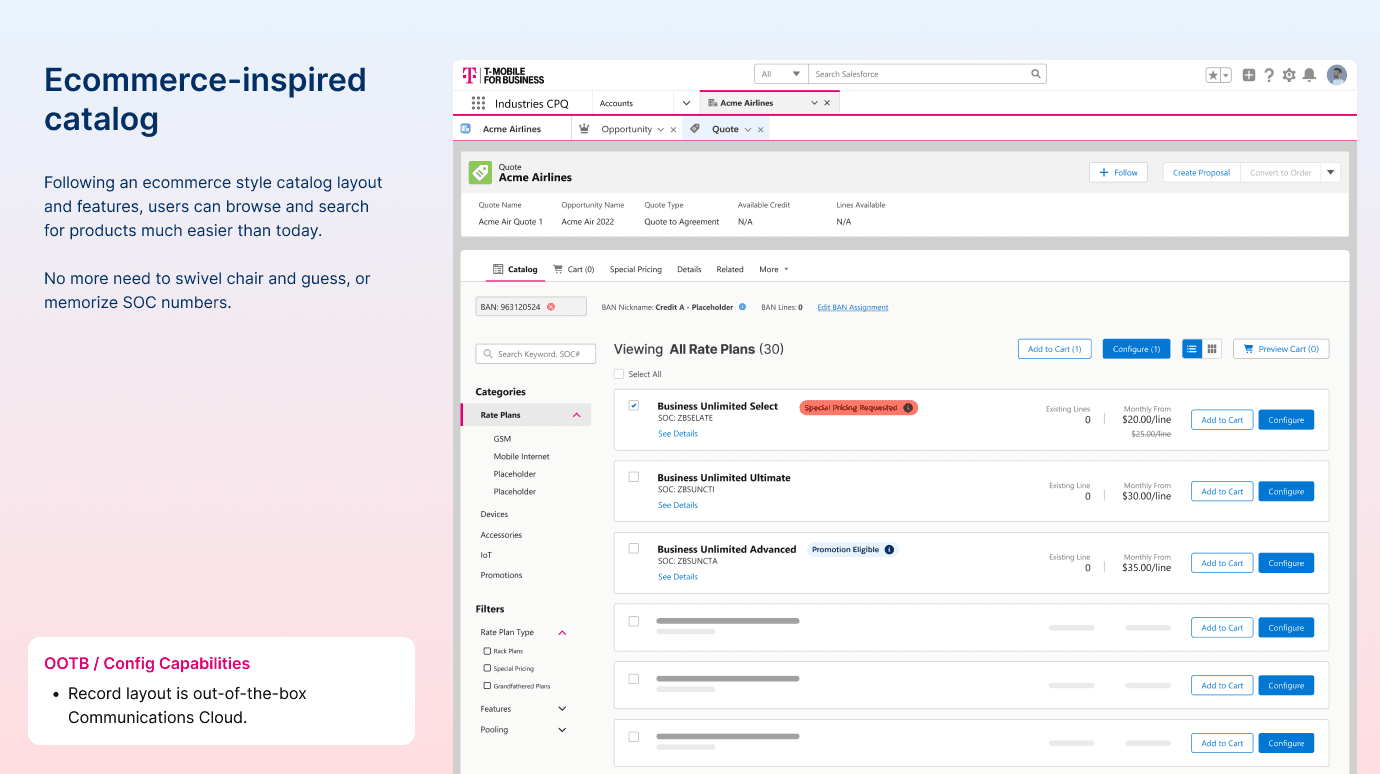
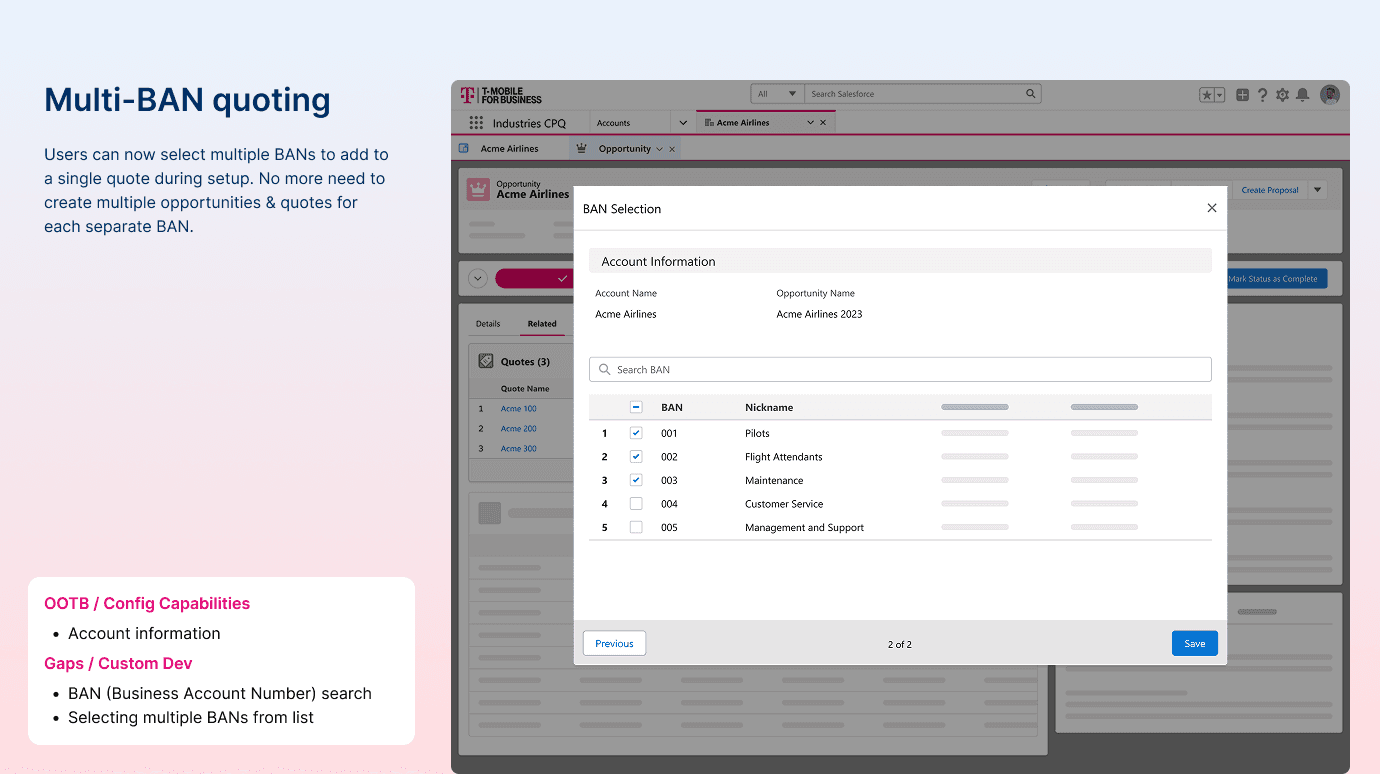
I designed 30+ concept screens across 14 key experience areas spanning the full CPQ flow. Each concept was annotated with OOTB/Config capabilities, UX considerations, and custom dev gaps — providing business and technical decision-makers with a clear picture of investment required at each stage. Key design decisions:


Results
Impact
Our work gave T-Mobile confidence and clarity to commit to their digital transformation with Salesforce Professional Services. T-Mobile booked $82M in services revenue to implement the Lead-to-Order vision we recommended.

